

 Minaam Jamil
 Feb 26, 2026
Jump To Section
Think of your thyroid as your body’s internal engine. This tiny, butterfly-shaped gland sits in your neck and pumps out hormones that tell your cells how fast or slow to work. When your thyroid is humming along perfectly, you feel energized and balanced.
But what happens when that engine starts revving too high or stalling out completely? That is exactly what happens with hyperthyroidism vs hypothyroidism, two sides of the same coin that can leave you feeling like a stranger in your own skin.
If you’ve been feeling unusually exhausted or strangely wired lately, you aren’t alone. One condition acts like an accelerator, speeding up your metabolism until your heart races and the pounds drop off without trying. The other acts like a brake, dragging your energy levels down, making you feel cold, and causing stubborn weight gain.
Understanding the difference between an overactive and underactive thyroid in Calgary is the first step toward reclaiming your health. We’re going to break down the symptoms, causes, and how you can naturally support your body to get back in sync.
Simply put, hyperthyroidism is when your thyroid gland becomes overactive. Instead of releasing just the right amount of hormones to keep your body steady, it goes into overdrive and floods your system with more than you need.
Think of it like a thermostat that is stuck in the “on” position; your body starts burning through energy much faster than it should.
This surge of excess hormones affects almost every organ, including your heart. Because your metabolism is running at a record pace, your body is essentially working overtime 24/7, which can leave you feeling physically exhausted even though your mind feels “wired.”
Recognizing hyperthyroidism symptoms early is key to slowing things down and getting your system back into a healthy rhythm.
If you are dealing with an overactive thyroid, you might notice your body reacting in ways that feel out of your control. Here are the most common hyperthyroidism symptoms to look out for:
Often causing unintentional weight loss, a rapid or irregular heartbeat (palpitations), anxiety, excessive sweating, heat sensitivity, and tremors, an overactive thyroid can significantly affect your daily life and overall well-being.
On the opposite end of the spectrum, we have hypothyroidism, which is essentially an underactive thyroid. In this case, your thyroid gland is “sleepy” and fails to produce enough essential hormones to keep your body running at full speed. It is a common condition where the thyroid gland fails to produce enough essential hormones, causing metabolism to slow down.
If hyperthyroidism is a racing engine, hypothyroidism is like trying to drive a car with a clogged fuel line; everything feels sluggish, heavy, and difficult to move.
When your hormone levels drop, your metabolism takes a major hit. Since these hormones are responsible for converting food into energy, a shortage means your body starts storing that energy instead of burning it. This slowdown doesn’t just affect your weight; it impacts your digestion, your brain function, and even your body temperature.
For many, especially when looking at symptoms of hypothyroidism, women often report that the change can feel like a sudden “wall” of exhaustion that no amount of caffeine can fix.
Because the body is slowing down, the symptoms tend to creep up gradually. You might dismiss them as “just getting older” or being stressed, but these are classic signs your thyroid needs help:
Recognizing these symptoms of hypothyroidism in women and men is the first step toward getting your energy back.
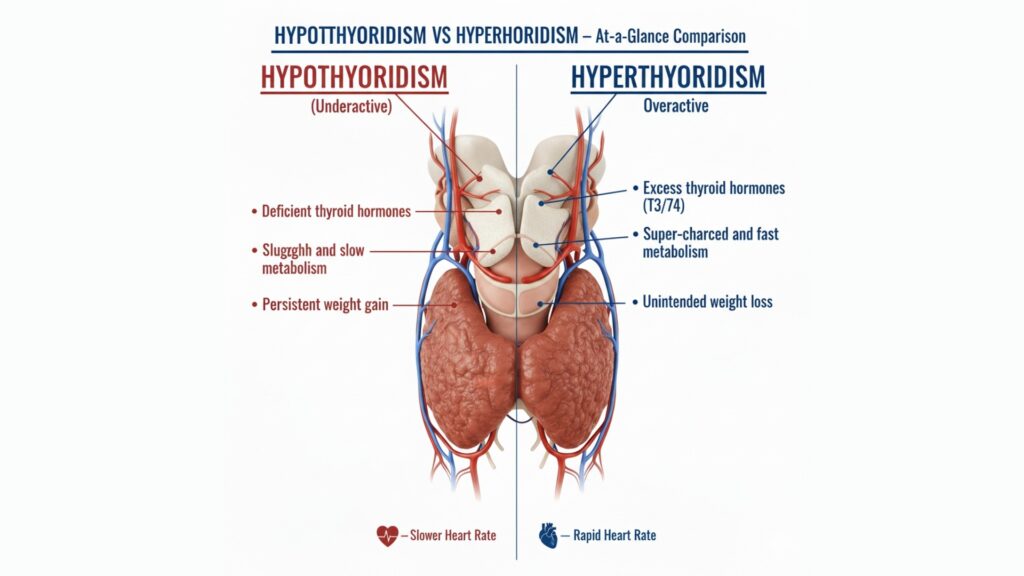
While both conditions involve the same small gland in your neck, they sit at opposite ends of the health spectrum. One speeds you up, while the other slows you down.
Understanding the differences between hypothyroidism and hyperthyroidism is much easier when you look at them side-by-side.
The main takeaway is that your thyroid acts as a control center. When it releases too much or too little hormone, it sends a ripple effect through every system in your body.
| Feature | Hyperthyroidism (Overactive) | Hypothyroidism (Underactive) |
| Hormone Levels | Excess thyroid hormones (T3/T4) | Deficient thyroid hormones |
| Metabolism Speed | Super-charged and fast | Sluggish and slow |
| Weight Changes | Unintended weight loss | Persistent weight gain |
| Heart Rate | Rapid, racing, or pounding | Slower than normal |
| Energy Levels | Restless, anxious, or “wired.” | Chronic fatigue and lethargy |
Understanding the cause of hyperthyroidism is like finding out why your car’s cruise control is stuck on high. It’s rarely just one thing; usually, an underlying trigger is telling your thyroid to ignore the “stop” signals from your brain.
While lifestyle factors like high stress can certainly play a role in how you feel, most cases stem from specific medical conditions that force the gland into overdrive.
Knowing what is happening behind the scenes helps you move away from just treating symptoms and toward addressing the root issue. Here are the most common factors that act as a cause of hyperthyroidism:
If hyperthyroidism is an engine revving too high, hypothyroidism is what happens when the fuel line is pinched. Understanding what causes hypothyroidism is essential because the treatment often depends on why the gland slowed down in the first place. For many, it isn’t just a “lazy” thyroid; it is often a response to an internal or external trigger that has disrupted the gland’s ability to do its job.
While lifestyle factors like chronic stress can certainly aggravate the situation, most cases of an underactive thyroid stem from these common underlying reasons:
While many thyroid issues develop slowly, some signs act like a “check engine” light that you simply shouldn’t ignore. Because your thyroid regulates vital functions like your heart rate and body temperature, a sudden shift can put a lot of strain on your system. If your body is sending out loud distress signals, it’s time to listen.
Pay close attention if you notice a combination of these warning signs, as they often indicate that your hormone levels are significantly out of balance. In rare cases, more serious conditions such as those associated with thyroid lymphoma symptoms can also present with rapidly worsening swelling in the neck, difficulty swallowing or breathing, or unexplained hoarseness.
If you suspect your metabolism is running too fast, you don’t have to keep guessing. Finding out how to detect hyperthyroidism is a straightforward process that usually starts with a simple conversation with your doctor about how you’ve been feeling.
Because the symptoms can mimic stress or caffeine sensitivity, medical professionals use a specific set of tools to see exactly what is happening with your hormone production.
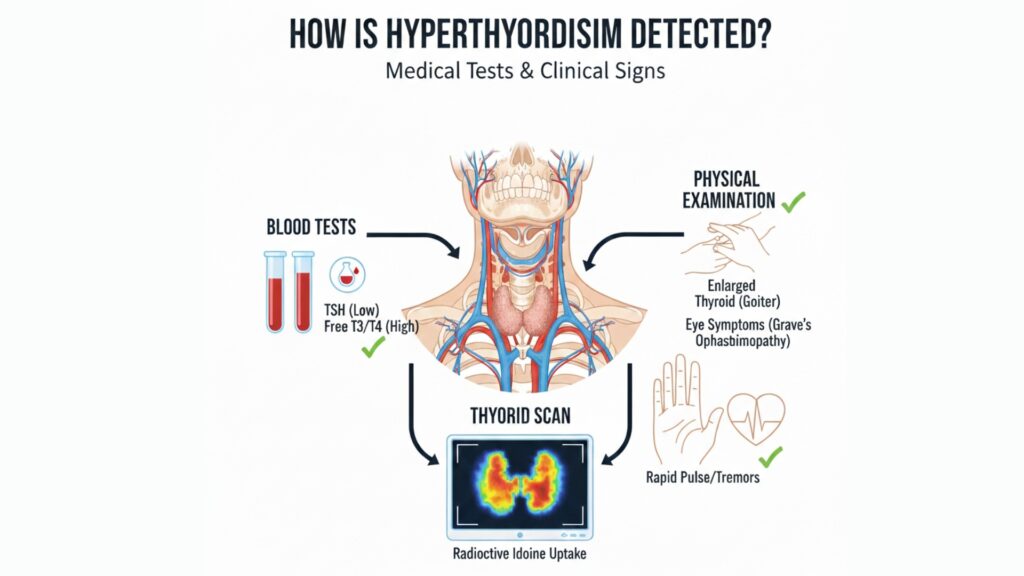
The sooner you get these tests done, the faster you can stop the racing heart and jittery feelings. Here are the primary ways doctors confirm an overactive thyroid:
| Method | What It Checks |
| Blood Tests | Measures levels of TSH, T3, and T4 to see if hormones are too high. |
| Thyroid Scan | Uses a small amount of radioactive iodine to see how the gland is functioning. |
| Physical Exam | Checks for tremors, skin changes, or a swollen thyroid gland. |
Key medical evaluations are used to accurately identify an overactive thyroid.
| Diagnostic Step | Description |
| Blood Tests (TSH, T3, T4) | The gold standard for detecting hyperthyroidism. A low TSH level combined with high T3 or T4 levels usually confirms that the thyroid is overactive. |
| Thyroid Scan | An imaging test that shows the size and shape of the thyroid and helps identify nodules responsible for excess hormone production. |
| Physical Examination | The doctor checks for signs such as a rapid pulse, moist skin, or bulging eyes, which are common indicators of certain thyroid conditions. |
Finding out if your metabolism has slowed down follows a similar path to checking for an overactive thyroid, but the results tell a very different story. If you’ve been feeling sluggish or struggling with persistent brain fog, knowing how to detect hypothyroidism starts with a simple screening process. Because the symptoms often overlap with general stress or aging, medical tests are the only way to get a definitive answer.
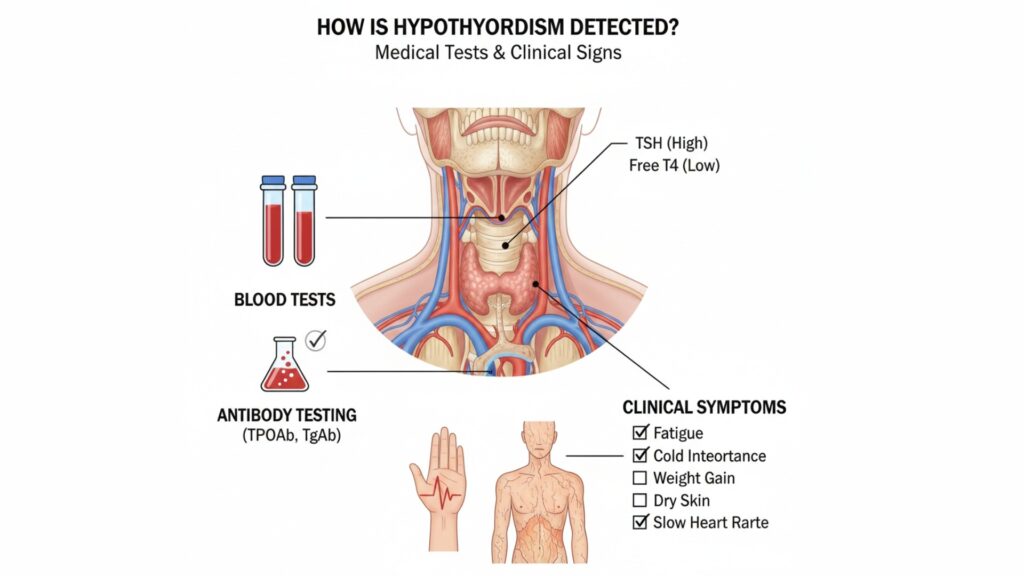
Doctors look for specific markers that show your thyroid is struggling to keep up with your body’s demands. Here is the standard process for uncovering an underactive thyroid:
| Detection Method | What It Measures | Why It Matters |
| TSH Blood Test | Thyroid-stimulating hormone levels | High TSH indicates your brain is “screaming” at your thyroid to work harder. |
| Antibody Testing | Presence of specific immune proteins | Helps determine if an autoimmune issue like Hashimoto’s is the cause. |
| Symptom Evaluation | Physical and mental health changes | Connects lab numbers to your real-world experience, like fatigue or cold skin. |
A step-by-step guide to the tests and evaluations doctors use to detect an underactive thyroid accurately.
| Screening Step | Description |
| TSH Blood Test | The most common first test. High TSH levels indicate that the brain is signaling the thyroid to produce more hormones. This is the primary method to accurately detect hypothyroidism. |
| Antibody Testing | Checks for specific antibodies to determine if an autoimmune condition, such as Hashimoto’s disease, is causing thyroid dysfunction. |
| Symptom Evaluation | A review of physical signs like slow heart rate, dry skin, or thinning hair. This helps the doctor understand how hormone deficiency affects daily life, complementing blood test results. |
While medical testing is the first step in identifying hyperthyroidism vs hypothyroidism, many people find that supporting their body holistically makes a world of difference in how they feel day-to-day. Your thyroid is incredibly sensitive to the world around you.
This means that while it can be easily thrown off balance, it also responds beautifully to gentle, consistent care through lifestyle and nutrition. Many individuals begin exploring natural remedies for thyroid support as a complementary approach alongside proper medical guidance.
The goal of a holistic approach isn’t to replace medical advice, but to create an environment where your thyroid doesn’t have to work so hard. By focusing on the root of your daily habits, you can often ease the intensity of your symptoms and improve your overall quality of life.
When managing the complexities of thyroid health, it is often beneficial to take a collaborative approach to your care. While an endocrinologist is the conventional specialist for hormonal imbalances, many people in Alberta seek out a natural health practitioner to address the lifestyle and nutritional foundations that support long-term recovery.
These practitioners focus on the “whole person” by evaluating how stress, gut health, and mineral deficiencies might be aggravating your symptoms. If you are looking for a personalized strategy that combines clinical insight with holistic wellness, exploring Natural Treatments for Thyroid in Calgary can provide you with the tools to manage your energy and metabolism more effectively alongside your standard medical checkups.
Understanding the tug-of-war between hyperthyroidism vs hypothyroidism is the first step toward feeling like yourself again. Whether your body is moving too fast or stalled in low gear, these symptoms are just your thyroid’s way of asking for help.
By paying attention to the “red flags,” knowing how to detect issues early, and supporting your body through healthy habits, you can bring your life back into a healthy balance.
Yes, both conditions can impact your readings. Hyperthyroidism often causes a racing heart and can lead to high blood pressure, while hypothyroidism can sometimes cause your blood pressure to rise as your heart works harder to pump blood through stiffened vessels.
Statistically, yes, thyroid conditions are significantly more common in women, more likely than men to develop thyroid issues, especially following pregnancy or during menopause. This is why being aware of the symptoms that women frequently report is so important for early detection.
Yes, consistent lifestyle changes can significantly help manage, reduce, and sometimes even reverse symptoms of chronic conditions like diabetes, heart disease, and mental health disorders.
My name is Minaam Jamil, and I’m a natural health practitioner with a background in pharmacy, a heart rooted in holistic healing, and a journey shaped by many cultures. I was born in Pakistan, lived in the UK, Middle East, and now call Calgary home. Each place gifted me a different kind of wisdom scientific, spiritual, ancestral and together they’ve shaped how I care for others. I started The Natural Healing Haven because I know what it feels like to search for answers that conventional medicine can’t always provide. After years in pharmacy and becoming a mother, I felt called to explore gentler, more intuitive ways of healing ones that honor the body’s design, the soul’s needs, and the sacred connection between the two.


