
 Minaam Jamil
 Mar 6, 2026
Jump To Section
Ever watched a championship game or the Olympics and wondered why the star players have those strange, circular bruises on their backs? It’s not a bizarre new trend or a mysterious injury.
It’s called cupping therapy, an ancient practice that has become the “secret weapon” for modern sports recovery. By using special suction cups for athletes, trainers are able to target deep muscle tension in a way that traditional massage often can’t reach.
So, how does cupping help athletes stay at the top of their game? From elite swimmers to pro football players, the world’s most physical performers are turning to this benefit of cupping therapy because it works with the body’s natural healing process.
Whether you’re a weekend warrior or a full-time pro, understanding why athletes do cupping can be the key to faster recovery and better performance without relying on harsh chemicals or invasive procedures.
At its core, cupping is a simple technique where a provider places specialized cups made of glass, silicone, or plastic directly onto your skin. Once the cups are in place, a vacuum is created inside them.
This can be done using a mechanical pump or, in more traditional settings, by briefly using heat to remove the oxygen before placing the cup down.
The magic happens through suction. While most bodywork (like massage) uses downward pressure to knead muscles, cupping does the opposite. It uses “negative pressure” to pull the skin, fascia, and top layers of muscle upward.
This suction causes your tiny blood vessels to expand, which creates that famous circular mark and encourages blood to rush into the area to begin the healing process.
Though it feels like a modern fitness trend, cupping has been around for thousands of years. It has deep roots in Traditional Chinese Medicine and ancient Egyptian and Middle Eastern cultures.
Historically, it was used to balance the body’s energy and treat everything from lung congestion to chronic pain. Today, we’ve simply adapted those ancient tools for modern athletic recovery.
There are two main ways this therapy is performed:
It isn’t just about looking cool on the sidelines; there are science-backed reasons why top performers swear by this treatment. Here is how those suction marks translate into real-world results:
When you look at the list of benefits, it’s clear why this isn’t just a fad. Here is a deeper look at what actually happens under those cups to help an athlete stay in peak condition:
| Main Benefit | How It Works for Your Body |
| 1. Supports Muscle Recovery | It speeds up the repair of micro-tears in muscle fibers by flushing out metabolic waste products like lactic acid. |
| 2. Improves Blood Flow | The suction creates “vasodilation,” which widens blood vessels to deliver a rush of oxygen and nutrients to tired tissues. |
| 3. Reduces Muscle Tension | By pulling the fascia and muscle layers apart, it breaks up stubborn knots and “stuck” tissues that cause stiffness. |
| 4. Helps With Inflammation | It draws inflammatory markers to the surface, allowing the lymphatic system to drain them more effectively. |
| 5. May Reduce Pain Naturally | The process can interrupt pain signals to the brain and trigger the release of endorphins, the body’s natural feel-good chemicals. |
| 6. Supports Relaxation | It stimulates the parasympathetic nervous system, helping athletes stay calm and sleep better before big events. |
If you’re nervous about your first session, don’t be! While the marks might look intense, the experience is quite different from what you’d expect. Most people find it deeply relaxing once they get used to the unique sensation.
Here is what you can expect during, before and after cupping therapy treatment:
Timing is everything in sports. Just like you wouldn’t do a heavy leg day right before a marathon, athletes are strategic about when they use their suction cups for athletes. To get the most out of the treatment, it is typically integrated into specific parts of a training cycle:
After Intense Workouts: This is the most common time. Using cupping therapy for athletes within 24 to 48 hours of a heavy session helps clear out the “junk” (metabolic waste) from the muscles, preventing that extreme stiffness that can set in two days later.
During Competition Season: When games or meets are back-to-back, the body doesn’t have much time to heal naturally. Athletes use cupping during the season to “reset” their muscles quickly so they can perform at 100% for the next event.
As Part of Recovery Days: On scheduled rest days, cupping is a great way to stay “active” in your recovery. It keeps the blood moving and the fascia loose without adding the stress of a workout.
Alongside Stretching and Mobility Work: Cupping is a team player. Many athletes find that if they use cups to loosen a tight area first, their stretching and mobility exercises become twice as effective because the “stuck” tissue has already been released.
When it comes to safety, the good news is that cupping is generally considered very safe for most athletes when performed by a trained professional or done properly with the right equipment.
Because it is a non-invasive therapy, it doesn’t involve the risks associated with medications or more intense procedures. Most people find that the biggest “risk” is simply looking like they’ve been hugged by a very friendly octopus for a few days.
Those famous temporary marks are a completely normal part of the process and are expected after a good session. While they might look like bruises, they are actually just a sign that blood has moved to the surface to help with the healing process.
However, it is always a good idea to listen to your body. If you have certain skin conditions like eczema, thin skin, or active rashes, cupping might not be the best choice for you at that moment, as the suction could cause extra irritation. As long as you keep things clean and follow a few simple steps, it remains one of the most reliable ways to keep your body feeling its best.
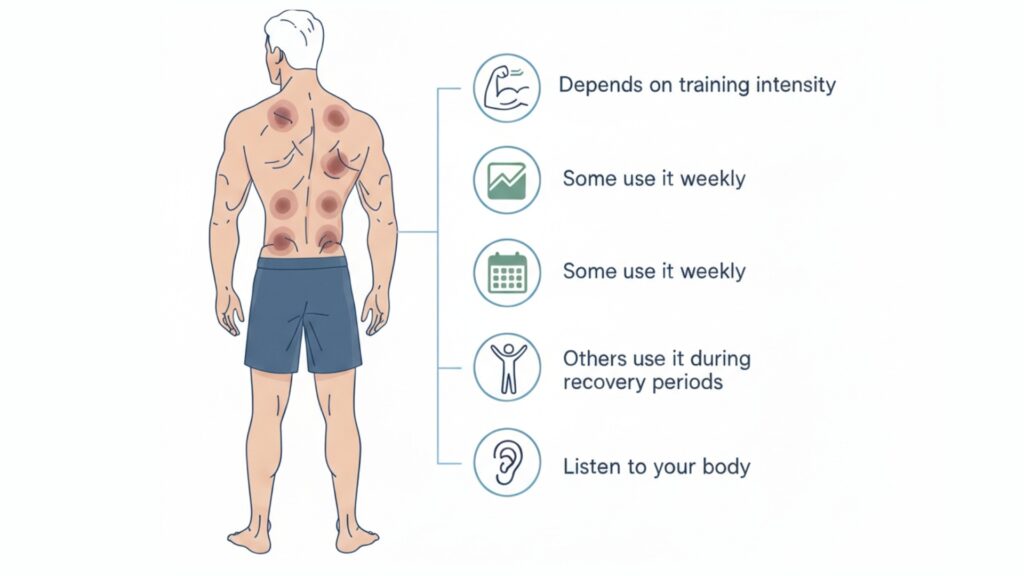
If you’ve decided to give it a try, you’re probably wondering how to fit it into your schedule. The truth is, there isn’t a one-size-fits-all answer because it largely depends on your training intensity and how your body reacts to the suction.
For many active individuals, a weekly session is the “sweet spot” to keep muscle tension at bay and maintain consistent blood flow. During a heavy competition season or a peak training block, some athletes might even bump this up to twice a week to handle the extra physical demand.
On the other hand, if you’re just using it for general maintenance, once or twice a month during your lighter recovery periods might be all you need to stay feeling loose.
The most important rule is to listen to your body. Since the goal is to support your natural healing process, you don’t want to overdo it. If your skin is still tender or the circular marks haven’t faded yet, it’s usually best to wait a few more days before your next session.
Think of it as a tool in your kit, use it when you feel that stubborn “heaviness” in your muscles or when your mobility feels restricted, and give your tissues the time they need to respond to the treatment.
While there are many ways to bounce back after a workout, cupping offers a unique “lift” that other techniques don’t provide. Here is how it stacks up against your usual recovery routine:
| Recovery Method | How It Compares to Cupping | How They Work Together |
| Massage | Massage uses downward pressure to knead muscles. Cupping uses upward suction to decompress them. | Use massage for overall relaxation and cupping for stubborn, deep-seated knots. |
| Stretching | Stretching pulls muscles lengthwise. Cupping pulls the tissue vertically, loosening the fascia (the muscle’s “wrapper”). | Cupping first “unsticks” the tissue, allowing you to get a much deeper, more effective stretch afterward. |
| Foam Rolling | Foam rolling is a DIY way to apply pressure. It can be painful on sore spots, whereas cupping is often more targeted and less “gritty.” | Use a foam roller for a quick daily flush and cupping once a week for deeper, focused recovery on problem areas. |
When you’re ready to try this treatment, it’s important to work with a qualified professional who understands how to tailor the session to your specific athletic needs. You should look for a Natural Health Practitioner who has specialized training in manual therapies, as they can ensure the suction is applied safely and effectively to target your unique muscle tension.
For those who want to take a more holistic approach to their wellness, consulting a specialized expert like a Calgary-based hijama cupping therapy calgary can be a turning point.
These professionals often integrate cupping into a broader plan that looks at everything from your internal recovery to your external performance, helping you feel your best from the inside out.
In summary, cupping therapy offers a powerful range of benefits, from flushing out metabolic waste and boosting circulation to releasing deep muscle tension and improving flexibility. Providing natural recovery support, it allows you to bounce back faster without the need for invasive treatments.
To get the best results, it is essential to maintain a balanced recovery routine where cupping acts as a vital part of your overall athletic wellness. By investing in these natural methods, you ensure your body stays fluid, pain-free, and ready to take on your next big challenge.
Yes. By creating negative pressure, cupping decompresses soft tissue, which increases blood flow and stretches the fascia (the connective tissue around muscles). This process helps clear out cellular debris and delivers oxygen-rich blood to tired muscles, effectively speeding up the body’s natural repair process.
It depends on your training volume. Most athletes find a “sweet spot” of once a week or once every two weeks during heavy training cycles. If you are in a maintenance phase, once a month is often enough to keep tissues pliable. Always wait for the marks from your previous session to fade before cupping the same area again.
Olympians use it primarily for quick recovery between heats or events. Because it is a non-invasive, drug-free way to reduce muscle soreness and improve range of motion, it allows them to maintain peak performance without the downtime required by more aggressive treatments. It also helps manage the physical and mental stress of high-stakes competition.
While “toxins” is a popular term, cupping specifically helps the body clear out metabolic waste products like lactic acid, calcium deposits, and uric acid that build up in the muscles after intense exercise. Drawing these to the surface, it makes it easier for your lymphatic system to process and eliminate them.
In traditional practice, the color of the mark indicates the level of “stagnation” in the area. A light pink mark suggests healthy circulation, while a dark purple or “bruise-like” circle usually indicates a high concentration of metabolic waste and poor blood flow in that specific muscle. These darker marks often appear in areas where you feel the most tension or chronic pain.
My name is Minaam Jamil, and I’m a natural health practitioner with a background in pharmacy, a heart rooted in holistic healing, and a journey shaped by many cultures. I was born in Pakistan, lived in the UK, Middle East, and now call Calgary home. Each place gifted me a different kind of wisdom scientific, spiritual, ancestral and together they’ve shaped how I care for others. I started The Natural Healing Haven because I know what it feels like to search for answers that conventional medicine can’t always provide. After years in pharmacy and becoming a mother, I felt called to explore gentler, more intuitive ways of healing ones that honor the body’s design, the soul’s needs, and the sacred connection between the two.


